Understanding AI vs automation is essential as businesses modernize their customer experience strategies. Today, brands are no longer asking what is a virtual agent—they’re exploring how intelligent systems can elevate every interaction. As customer service AI trends continue to accelerate, companies are shifting from simple automated tasks to truly conversational, AI-driven support that improves efficiency and satisfaction.
As the debate around AI and automation continues, companies are also looking at supporting technologies that strengthen both capabilities. One major area driving this shift is the rise of cloud-enabled intelligent computing frameworks, which allow teams to scale AI tools, store data securely, and operate across global environments without heavy infrastructure. These cloud resources make it easier to combine learning models with automated workflows, helping organizations work smoother and adapt faster.
Advances in next-generation computer technology systems are also transforming the conversation. Modern computing no longer focuses solely on raw performance — it focuses on adaptable tools that can reason, recognize patterns, and support decision-making. When paired with automation, these intelligent systems reduce errors, respond to changes quickly, and keep operations consistent.
In marketing, brands increasingly rely on AI-supported customer engagement strategies to better understand users, personalize content, and deliver more relevant messages. At the same time, data-driven digital marketing approaches using AI help organizations target audiences more accurately and make smarter decisions about where to invest. Automation amplifies these advantages by handling repetitive tasks, while AI adds insight and creativity.
Finance is experiencing a similar evolution. Companies now adopt advanced financial insight platforms powered by AI to assess risks, flag unusual patterns, and improve forecasting accuracy. Automation ensures stability and speed, while AI provides deeper intelligence that strengthens financial oversight.
Together, these advancements form a unified ecosystem where automation maintains reliability and speed, while AI brings adaptability and smart decision-making. When these technologies work together, organizations gain a stronger, more flexible path toward growth and innovation — all within the broader understanding of AI vs automation.
Top Contact Center Solutions That Show How AI vs Automation Shapes the Future of Customer Experience
As businesses rethink how modern customer service works, many are turning to platforms that blend intelligent AI features with reliable automation. These solutions show how companies can use both technologies together to improve efficiency, personalize conversations, and reduce operational burdens. Below is a list of top providers leading the way.
1. Bright Pattern – AI-Ready Contact Center Platform for Smarter, Faster Customer Engagement
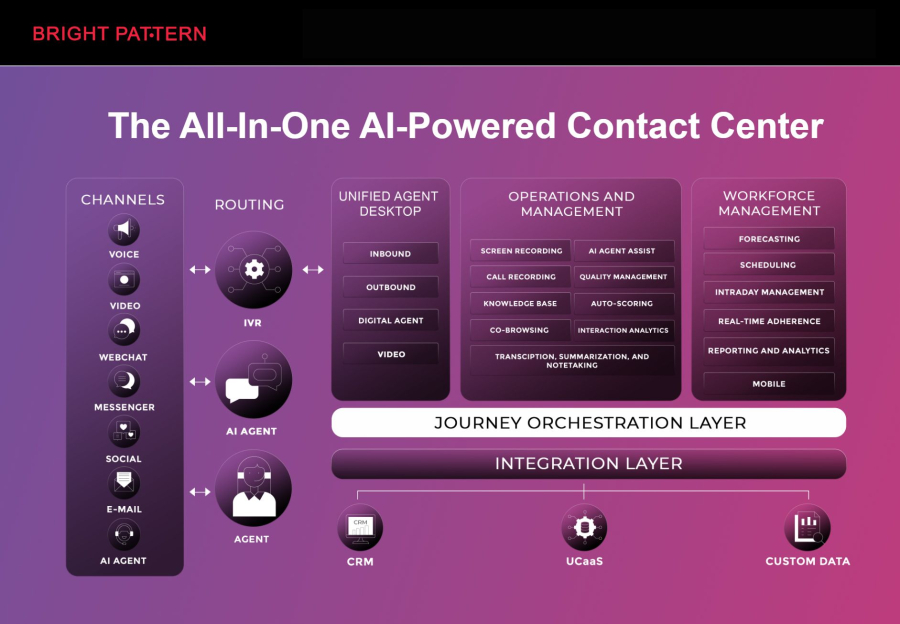
Bright Pattern stands out as a leading contact center solution due to its strong focus on combining adaptive AI tools with stable automated workflows. Its platform makes it simple for organizations to deploy AI-powered routing, intelligent quality management, and seamless omnichannel support. This balanced approach helps teams deliver great experiences while reducing repetitive workload.
Bright Pattern also offers flexible capabilities that support the evolving needs of modern service teams. Its AI-driven insights, automated case handling, and intuitive agent tools help organizations scale their operations without sacrificing service quality. This creates a powerful advantage for companies looking to enhance customer satisfaction while controlling operational costs.
Key strengths of Bright Pattern’s AI contact center solutions:
- AI-enhanced routing that connects customers with the best available agent or automated resource
- Automated workflows that speed up ticket resolution and reduce manual tasks
- Smart agent assistance that provides real-time suggestions and knowledge guidance
- Omnichannel support with consistent experiences across voice, chat, email, and messaging
- Insightful analytics that use AI to detect patterns, improve quality, and support decision-making
With this combined approach, Bright Pattern gives organizations a unified way to leverage AI and automation together—without adding complexity.
2. Five9
Five9 offers a flexible cloud contact center with strong automation tools and AI capabilities designed to streamline service operations. It helps teams improve both speed and accuracy through intelligent routing and agent assist features.
3. NICE CXone
NICE CXone provides an enterprise-level system with advanced AI capabilities that enhance quality management and customer engagement. Its automation tools support large teams by reducing repetitive work and improving forecasting accuracy.
4. Genesys Cloud CX
Genesys Cloud CX uses predictive AI to improve routing, personalize interactions, and optimize workforce planning. Its automation tools help organizations manage high-volume environments with consistent service quality.
5. Talkdesk
Talkdesk delivers an AI-focused contact center platform that helps companies enhance customer experiences through automated workflows and virtual assistants. It is known for its strong integrations and fast deployment capabilities.
6. RingCentral Contact Center
RingCentral offers a scalable platform with AI-powered routing, agent support, and automated case management. It helps organizations streamline conversations across multiple channels with unified reporting.
7. Zendesk for Service
Zendesk for Service combines intuitive tools with AI-driven insights to help teams manage conversations more effectively. Its automation features reduce manual work and support faster response times across digital channels.
8. Avaya Experience Platform
Avaya’s platform supports enterprise operations with intelligent routing, automated workflows, and strong voice capabilities. It enables organizations to modernize traditional contact centers with AI-powered enhancements.
9. Cisco Webex Contact Center
Cisco Webex Contact Center brings together AI analytics, intelligent routing, and collaboration tools to improve service delivery. Its automation features simplify tasks and help teams manage high-volume support.
10. 8x8 Contact Center
8x8 provides an integrated contact center solution with strong voice and digital support tools powered by AI insights. Its automation features help reduce workload while maintaining consistent, high-quality customer experiences.
Automation vs AI in One Sentence
If you remember only one idea, make it this:
Automationfollows fixed rules to complete repetitive tasks;AIlearns from data to make decisions and adapt to new situations.
Both save time and money — but they shine in different ways.
What Is Automation?
Automationis the use of technology to perform tasks with minimal human intervention, based on predefined rules or workflows. It is about consistency, speed, and reliability.
Key Traits of Traditional Automation
- Rule based: Follows explicit instructions such as "if X happens, do Y."
- Predictable: Works best in stable, repetitive processes.
- Deterministic: Same input always produces the same output.
- Requires clear structure: You must be able to describe the process step by step.
Examples of Automation in Action
- Invoice routing: When an invoice is received, it is automatically forwarded to the right approver.
- Payroll processing: Salaries, taxes, and benefits are calculated and paid on a fixed schedule.
- Email workflows: New subscribers automatically receive a welcome email sequence.
- Manufacturing robots: Machines repeat the same movements on an assembly line.
In all these cases, the process is highly defined. If something unexpected happens, traditional automation often stops and asks for human help.
What Is Artificial Intelligence (AI)?
Artificial Intelligencerefers to systems that can perform tasks that typically require human intelligence, such as understanding language, recognizing patterns, making predictions, and adapting over time.
Key Traits of AI
- Data driven: Learns from examples and historical data rather than only from fixed rules.
- Probabilistic: Produces outcomes based on likelihoods and patterns, not strict yes or no rules.
- Adaptive: Improves with feedback and exposure to new data.
- Handles complexity: Works well in messy, ambiguous, or constantly changing environments.
Examples of AI in Action
- Customer support assistantsthat understand natural language questions and provide relevant answers.
- Recommendation enginesthat suggest products, content, or services tailored to each user.
- Fraud detection modelsthat scan thousands of transactions and flag suspicious patterns.
- Predictive maintenancethat analyzes sensor data to forecast when machines will need service.
These systems do not just follow a script. They detect patterns, weigh probabilities, and adjust to new information over time.
AI vs Automation: Side by Side
The table below highlights the core differences and how each technology adds value.
|
Aspect |
Traditional Automation |
AI |
|
Core idea |
Executes predefined rules |
Learns patterns from data |
|
Best for |
Stable, repetitive tasks |
Complex, variable decisions |
|
Inputs |
Structured, predictable |
Structured and unstructured (text, images, etc.) |
|
Output |
Deterministic and repeatable |
Probabilistic and context dependent |
|
Adaptability |
Low — changes require reprogramming |
High — can improve with new data |
|
Human involvement |
Designs rules and handles exceptions |
Provides oversight, training data, and feedback |
|
Main benefit |
Speed and consistency |
Smart decisions at scale |
Where Automation Shines
Automation has been transforming operations for decades — and it is still incredibly powerful. When your process is stable and well understood, automation can deliver impressive returns.
Benefits of Traditional Automation
- Massive time savings: Eliminate manual, repetitive work so your team can focus on higher value tasks.
- Consistency and quality: Reduce human error and ensure tasks are completed the same way every time.
- Scalability: Handle higher volumes without needing to grow headcount at the same rate.
- Compliance and traceability: Standardized workflows make audits easier and provide clear records.
Great Use Cases for Automation
- Back office workflows: Document routing, approvals, and notifications.
- Data syncingbetween systems: Moving information from one application to another on a schedule.
- Production lines: Repeating the same manufacturing steps at high speed.
- Routine IT tasks: Account provisioning, backups, scheduled reports.
If the work can be described as a clear set of steps and rarely changes, traditional automation is usually the most reliable, cost effective option.
Where AI Shines
AI becomes especially valuable when rules are hard to write, data is messy, or decisions depend on context. In those situations, trying to hard code every rule quickly becomes unmanageable.
Benefits of AI
- Better decisions, faster: AI can examine far more data than a human and surface insights in real time.
- Personalization at scale: Tailor experiences, offers, and communication to each individual user.
- Continuous improvement: Models can be retrained and refined as they encounter new patterns.
- Flexibility in uncertain environments: AI handles variability and ambiguity far better than rigid rules.
Great Use Cases for AI
- Customer experience: Conversational assistants, smart routing of support tickets, sentiment analysis.
- Sales and marketing: Lead scoring, churn prediction, content recommendations.
- Operations: Demand forecasting, inventory optimization, dynamic pricing.
- Risk management: Detecting fraud, anomalies, and unusual behavior patterns.
In these areas, AI does not just move faster; it can unlock decisions and insights that would be impractical or impossible with manual analysis alone.
AI vs Automation Is a False Choice
AI and automation are often presented as competitors, but in practice they are complementary. The most powerful solutions combine both:
- Automationorchestrates workflows and handles repetitive steps.
- AIplugs into those workflows to make smart, data driven decisions.
Think of automation as the reliable engine that runs your processes, and AI as the intelligent co pilot that helps you decide what to do next. Together, they can elevate both efficiency and quality of outcomes.
Practical Examples of AI Powered Automation
Example 1: Smarter Customer Support
Traditional automation alonemight:
- Automatically create a ticket when an email arrives.
- Assign it to a queue based on a keyword in the subject line.
- Send a standard confirmation reply.
AI with automationcan:
- Read the full message and understand the customer’s intent.
- Route the ticket to the right agent based on topic, urgency, and sentiment.
- Suggest a draft reply or relevant help article to the agent.
- Escalate automatically if the customer appears frustrated or high value.
The workflow is automated, but thedecisionsinside the workflow are powered by AI. The result: faster responses, higher satisfaction, and less manual triage.
Example 2: Intelligent Invoice Processing
Traditional automation alonemight:
- Receive invoices through a portal or inbox.
- Route them to predefined approvers based on vendor.
- Trigger payment after approval.
AI with automationcan:
- Extract key fields from invoices even if layouts differ.
- Check amounts and line items against purchase orders.
- Flag anomalies or potential duplicate invoices.
- Prioritize or schedule payments based on cash flow rules.
Again, automation manages the flow; AI handles interpretation, validation, and risk detection. Accounts payable becomes faster, more accurate, and more strategic.
Example 3: Sales Outreach That Adapts
Traditional automation alonemight:
- Send the same email sequence to every new lead.
- Trigger follow ups based on fixed time delays.
AI with automationcan:
- Score leads based on behavior and fit.
- Personalize messaging based on interests and previous interactions.
- Trigger follow ups when engagement signals indicate the right moment.
This combination keeps processes efficient while making each interaction more relevant and effective.
How to Decide: AI, Automation, or Both?
When you are evaluating a process, a useful question is:Is this mostly about repeating steps, or mostly about making decisions?
Use Automation When:
- The steps are clear, repeatable, and rarely change.
- Inputs and outputs are structured and predictable.
- Accuracy depends more on following the process than on interpreting data.
- Your main goal is speed, consistency, and cost reduction.
Use AI When:
- Rules are hard to define, or there are too many to maintain manually.
- Data is noisy, unstructured, or constantly changing.
- You need predictions, recommendations, or classification at scale.
- Your main goal is better decisions, not just faster execution.
Use Both When:
- You have a repeatable process that includes complex judgment calls.
- Parts of the workflow are stable, but inputs or decisions vary.
- You want to elevate existing automation instead of replacing it.
Most high impact opportunities fall in this last category. You keep your proven automations, then layer AI on top to make them smarter and more responsive.
Benefits of Combining AI and Automation
When you bring AI and automation together, you create a powerful foundation for modern, digital first operations. Key benefits include:
- End to end efficiency: Routine work is automated, while complex decisions are accelerated by AI insights.
- Higher quality outcomes: Fewer errors, more relevant recommendations, and better experiences for customers and employees.
- Agility and resilience: As conditions change, AI can adapt models, and automation can be reconfigured without redesigning everything from scratch.
- Better use of human expertise: People spend less time on low value tasks and more time on strategy, relationships, and innovation.
Common Misconceptions About AI vs Automation
“AI Will Replace All Automation”
In reality, AI does not eliminate the need for automation. You still need reliable workflows to move data, trigger actions, and enforce business rules. AI enhances those workflows; it does not replace them.
“Automation Is Old, AI Is New — So We Should Skip Straight to AI”
Traditional automation is a proven way to generate fast returns and build a solid foundation. In many cases, the most effective path is:
- Streamline and automate existing processes.
- Use the data generated by automation to train AI models.
- Gradually add AI to handle complex decisions inside automated workflows.
This step by step approach lowers risk and maximizes value.
“AI and Automation Are Only for Large Enterprises”
Historically, advanced automation and AI required heavy investment. Today, many tools are accessible to small and mid sized businesses. You can start small — such as automating simple workflows or using AI tools for specific tasks — and expand as you see results.
Building an AI and Automation Roadmap
To capture the full benefits of both AI and automation, it helps to follow a structured plan.
1. Map Your Processes
- List key workflows across departments.
- Identify where time is lost, errors occur, or handoffs break down.
- Note which steps are repetitive versus judgment based.
2. Prioritize High Impact Opportunities
- Target processes that are frequent, time consuming, and closely tied to revenue, cost, or customer satisfaction.
- Start with quick wins that are easy to automate or augment with AI.
3. Decide on Automation, AI, or Both
- Use automation for clearly defined, repetitive tasks.
- Use AI where pattern recognition or prediction creates additional value.
- Combine them for end to end, intelligent workflows.
4. Measure and Iterate
- Track metrics such as time saved, error rates, customer satisfaction, and cost per transaction.
- Review performance regularly and adjust rules, models, and workflows.
- Use feedback from employees and customers to guide improvements.
The Human Role in an AI and Automation World
Both AI and automation shift the nature of work, but they do not remove the need for people. Instead, they change where human strengths have the biggest impact.
- Strategy and creativity: Defining goals, designing new services, and exploring innovative ideas.
- Relationship building: Understanding nuanced human needs, building trust, and navigating complex negotiations.
- Ethical and responsible oversight: Ensuring AI and automation are used fairly, safely, and transparently.
- Exception handling: Managing novel or sensitive cases that do not fit existing patterns.
When you combine the reliability of automation, the intelligence of AI, and the insight of people, you create a powerful, future ready organization.
Key Takeaways: AI vs Automation
- Automationis about executing predefined tasks quickly and consistently.
- AIis about learning from data to make smarter, more adaptive decisions.
- They are most powerful when used together inside end to end workflows.
- Start by automating clear, repetitive tasks, then layer on AI where judgment and prediction matter most.
- The ultimate goal is not just efficiency, but better outcomes for your customers, your team, and your business.
By understanding the strengths of both AI and automation — and how they complement each other — you can design smarter processes, unlock new opportunities, and build a resilient, competitive edge in the years ahead.
